A Few More Tips on the Nose with Rob Silverman

A Few More Tips on the Nose with Rob Silverman

portraiture, rob silverman, portraits, nose, nose tips, painting tips, oil tip  

A Few More Tips on the Nose
with Rob Silverman

1. NASAL STRUCTURE

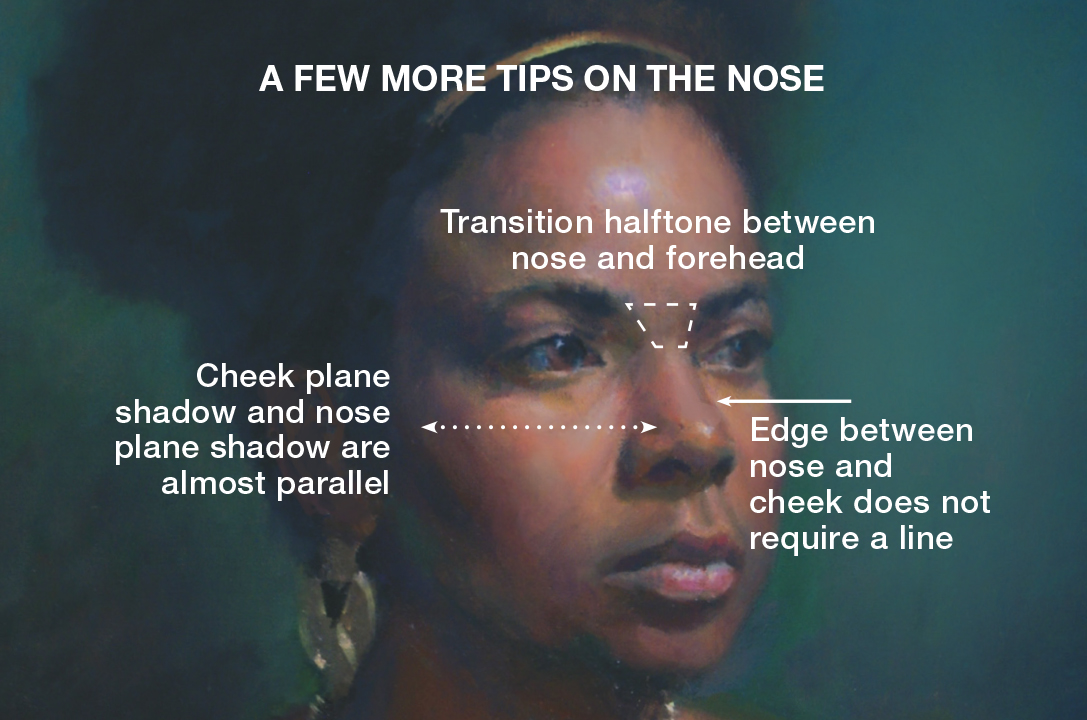
Trapezoid shape, the glabella, between nose and forehead is turned down at an angle, creating a slight halftone.

2. PROFILE

Avoid delineating the bridge of the nose (the side that is turned away from the light source) with a hard line. Use a slight tonal change instead.

3. SHADOW

Nose side plane and cheek plane are familial—the planes are generally parallel, although the nose shadow is made a bit lighter from the reflected light bouncing from the cheek.

_______________________

About Rob Silverman:

Rob Silverman’s innovative techniques have been featured in American Artist Workshop Magazine and The Art of the Portrait, the official publication of the Portrait Society of America. His work has appeared at Crosby Street Gallery and Spring Studio Gallery in Soho, the Art League of Long Island, Edward Hopper House, The Art Guild of Port Washington, The National Art League, the Lockwood-Mathews Museum, as well as the National Arts Club and Salmagundi Club. View his work at silvermanportraits.com

Rob teaches New Strategies & Techniques in Portraiture at The Art Guild on Mondays.

TAG at Home

[catlist name=tag-at-home]

Exercise your brain & enhance creativity with Shelley Holtzman

Exercise your brain & enhance creativity with Shelley Holtzman


Enhance your Creativity with Shelley Holtzman

Drawing with your non-dominant hand helps you get to the core of how you process an image.  The act confuses your brain and leads to creativity. 


Using your non-dominant hand forces you to draw what you see rather than what you know. Lowering your expectations for the finished drawing allows you to make interesting marks and breakthrough the predictable. 

It also is a great exercise for improving brain functioning in general!  So what do you have to lose?  Try it!    

_______________________

About Shelley Holzman

Shelley Holzman  Shelley Holtzman is Co-President of The Art Guild and a member of the Port Washington Library Art Advisory Council.  A former art director for a New York ad agency, her experience with graphic design is evidenced in her work, which emphasizes strong lines and vivid contrasts.  Painting in watercolor or oil, her passion for color can be seen in her florals, landscapes and portraits as she strives to illuminate the vibrancy of people and world around us. Shelley’s art can be viewed at ShelleyHoltzman.com 

Shelley is also a designer for Vida, a sustainable socially conscious global company. Her designs can be viewed at shopvida.com/shelley-holtzman


TAG at Home

[catlist name=tag-at-home]

Creating Color Swatches with Katrina Benson

Creating Color Swatches with Katrina Benson

Katrina Benson, Cherries, Color Swatch, color swatch tips, TAG at home, art class, art tip, art lesson

Creating a Color Swatch from a Reference Photo with Katrina Benson

Painting from a photograph? 

As artists, we can choose how we render what we see. We may want a realistic representation of our reference, or not at all.  Either way, it can be helpful to verify that the colors and values we perceive in our reference are what’s actually there. 

We know that our perception of colors and values isn’t always accurate.  Their appearance will be different, and often misleading, depending on the surrounding colors and values. 


A very simple way to verify colors is to create swatches using a photo app.  This Screencast tutorial shows a quick and simple way to pull color swatches from a photo using a free web-based photo app.  The steps shown are basically the same for all photo editing programs, so the method is transferable to other software such as Photoshop and Affinity Photo.

View the video here: Katrina Benson’s Creating a Color Swatch from Reference Photo

_______________________

About Katrina Benson:

Katrina Benson is the Vice President of the Art Guild and an award-winning artist working primarily in colored pencil and watercolor. Her work gravitates toward realism, although she enjoys all forms of artistic expression and experimentation. Working in realism is an opportunity to explore easily overlooked nuances in the world around me. The process of looking deeply and interpreting with each stroke gives me a profound sense of connection and gratitude for the wonders of even the simplest of objects.”  Find out more about Katrina on her website www.kblfineart.com.

Katrina teaches Colored Pencil: Foundational Techniques

TAG at Home

[catlist name=tag-at-home]

Sketch your Day with Stephanie Navon-Jacobson

Sketch your Day with Stephanie Navon-Jacobson

Sketch Your Day with Stephanie Navon-Jacobson


Use one of these drawing prompts to record something from your day:

Where did I go?

What did I see?

What did I wear?

What did I eat/drink?

What did I use/handle/touch?

What did I buy?

What’s new?

What’s old?

What did I throw out?

What’s the same as usual (a routing or repetitive event??

What’s different than usual (a unique event)?

What’s a random thing that happened?

One this day, what will be a memory?

_______________________

About Stephanie Navon Jacobson:

Stephanie Navon Jacobson, Art Guild, Art Guild teacher, Art Guild instructor  Stephanie Navon-Jacobson As an artist, I am always observing the world around me.Whether floral, landscape, animal, or figure, abstract or realistic, my images always go back to nature. I am first and foremost a printmaker, although I work in other mediums, too. I am a printmaker who paints, rather than a painter who prints.

I was originally attracted to printmaking in college. I loved the studio community aspect as well as the various techniques. I like to experiment with various techniques. The possibilities seem endless. I also like the element of surprise each time you pull a print.

It is so satisfying to work with people who are new to printmaking or to teach experienced artists a new technique and watch their enthusiasm as they ‘get bit by the printmaking bug.’ Printmaking is such a versatile medium. It can stand alone or be incorporated with other mediums such as oil or watercolor. I encourage my students to add printmaking to their artistic arsenal and incorporate it with their other artistic endeavors.


TAG at Home

[catlist name=tag-at-home]

Blind Contour with Marc Isaacs

Blind Contour with Marc Isaacs

Blind Contour Drawing

with Marc Isaacs


Blind contour drawing is the best friend to an artist and it often comes before contour drawing, but not necessarily. It should be repeated daily even by the experienced hand as it is great practice.

 If you have been introduced to contour drawing previously then you have half an understanding, now for the other half…

You may not look at the paper on which you draw and you may draw over and over on the same paper with overlapping being perfectly ok. 

The goal is an exercise, not a finished image. The pencil is your barbell. The only reason to keep the practice papers is to observe progress. The jump can be surprising.

Here we go:

  1. We need an objector model, a pencil and paper and a large paper plate. Poke a hole in the paper plate center and slide the pencil through until it reaches almost to the top of the pencil, near the eraser area. Now the pencil has a hat. 
  2. Look at one side of the object to start, we can see the whole object later. Place the tip of the pencil on the paper. Be sure you cannot see the surface where the mark-making takes place.
  3.  Imagine your eye and the point of the pencil to be in the same spot. Trace the edge of the model as if by an imaginary laser pointer without lifting the pencil. 

It may help if you verbally describe each bit as you go. Saying things like I move the tip downward to a step and I am moving my pencil over it away from the main body, down a little, and back in towards the body, continuing downward … the more descriptive the better as it will slow you down to training speed.

Eventually, you will go silent altogether. The other key point is to remember that although you are some distance away from the object you will guide the pencil as if actually touching it. A fun challenge is to skip the paper plate and honor yourself by not looking at the paper. Toss away the eraser as you won’t need it at all.

 With practice, the eye-hand coordination will grow beyond expectation.

_______________________

About Marc Isaacs:

Marc Isaacs, Art Guild   Marc Isaacs is an award-winning Long Island artist and teacher, with a degree in Art Education and a Masters in Fine Arts. His work is in collections in the US, Taiwan and Japan and periodically in the Metropolitan Museum in New York City as well as Huntington’s Heckscher Museum.  Whether teaching drawing, clay or paint in two dimensions or three, he has a unique teaching philosophy which he calls “solving art.” Students are taught to create links between the dimensions and develop art skills which they can carry across education. He teaches students to work with conventional materials as well as tools and found objects in order to enhance their tactile and environmental awareness. He currently teaches for the Art Guild, YMCA, Friends Academy, and the North Shore school district.
TAG at Home

[catlist name=tag-at-home]