A Few More Tips on the Nose with Rob Silverman

A Few More Tips on the Nose with Rob Silverman

portraiture, rob silverman, portraits, nose, nose tips, painting tips, oil tip  

A Few More Tips on the Nose
with Rob Silverman

1. NASAL STRUCTURE

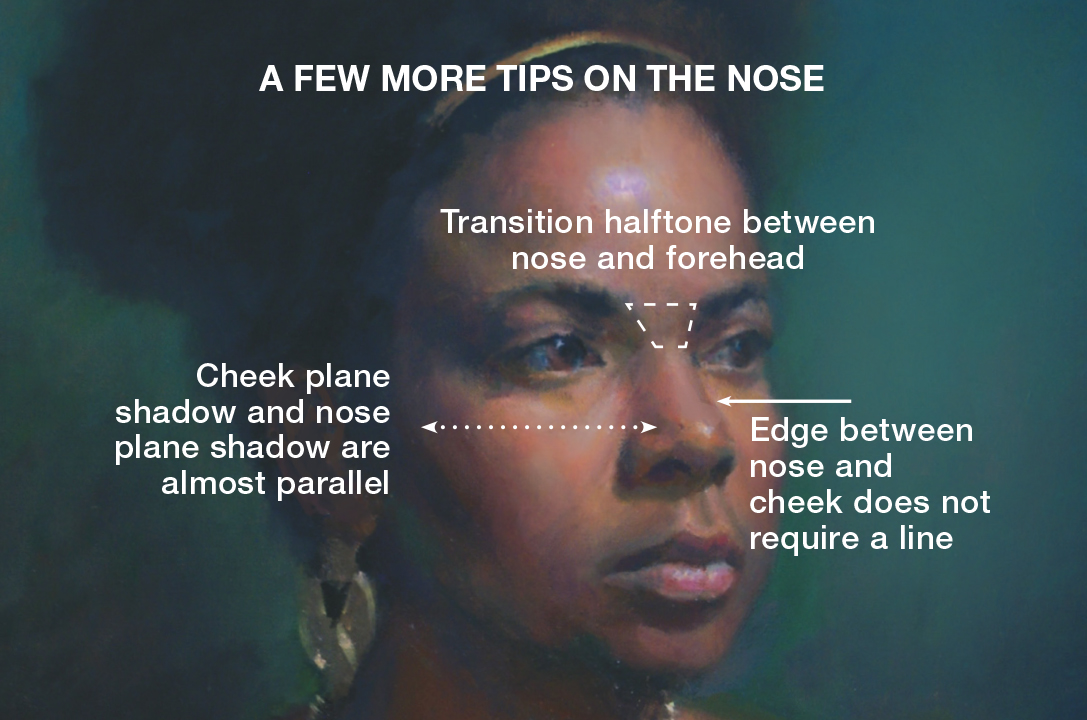
Trapezoid shape, the glabella, between nose and forehead is turned down at an angle, creating a slight halftone.

2. PROFILE

Avoid delineating the bridge of the nose (the side that is turned away from the light source) with a hard line. Use a slight tonal change instead.

3. SHADOW

Nose side plane and cheek plane are familial—the planes are generally parallel, although the nose shadow is made a bit lighter from the reflected light bouncing from the cheek.

_______________________

About Rob Silverman:

Rob Silverman’s innovative techniques have been featured in American Artist Workshop Magazine and The Art of the Portrait, the official publication of the Portrait Society of America. His work has appeared at Crosby Street Gallery and Spring Studio Gallery in Soho, the Art League of Long Island, Edward Hopper House, The Art Guild of Port Washington, The National Art League, the Lockwood-Mathews Museum, as well as the National Arts Club and Salmagundi Club. View his work at silvermanportraits.com

Rob teaches New Strategies & Techniques in Portraiture at The Art Guild on Mondays.

TAG at Home

[catlist name=tag-at-home]

Exercise your brain & enhance creativity with Shelley Holtzman

Exercise your brain & enhance creativity with Shelley Holtzman


Enhance your Creativity with Shelley Holtzman

Drawing with your non-dominant hand helps you get to the core of how you process an image.  The act confuses your brain and leads to creativity. 


Using your non-dominant hand forces you to draw what you see rather than what you know. Lowering your expectations for the finished drawing allows you to make interesting marks and breakthrough the predictable. 

It also is a great exercise for improving brain functioning in general!  So what do you have to lose?  Try it!    

_______________________

About Shelley Holzman

Shelley Holzman  Shelley Holtzman is Co-President of The Art Guild and a member of the Port Washington Library Art Advisory Council.  A former art director for a New York ad agency, her experience with graphic design is evidenced in her work, which emphasizes strong lines and vivid contrasts.  Painting in watercolor or oil, her passion for color can be seen in her florals, landscapes and portraits as she strives to illuminate the vibrancy of people and world around us. Shelley’s art can be viewed at ShelleyHoltzman.com 

Shelley is also a designer for Vida, a sustainable socially conscious global company. Her designs can be viewed at shopvida.com/shelley-holtzman


TAG at Home

[catlist name=tag-at-home]

Using a Fill Flash Outdoors with Daniel Kasle

Using a Fill Flash Outdoors with Daniel Kasle

Using a Fill Flash Outdoors

with Daniel Kasle

Many new and indeed some experienced photographers are skittish about using a flash in an outdoor setting.  Maybe it just isn’t intuitive to bring more light to a brightly lit situation but the simple illustration below shows just how useful a little fill flash can be even in bright sunlight.

 All three featured images were taken at 1/200 sec, f4.5 and ISO 64.

 On a bright sunny day, the harshness of the light, especially around midday, can make creating even a simple portrait a real headache.  Should I have my subject facing the sun?  Back to the sun?  Side angle?  As you move around and try each angle, you may just give up after a few shots of each because none of them look just right.  Waiting for a cloud to pass in front of the sun or finding a shady area may be best but sometimes its just not available and, even if it is, the light might be dappled causing light and dark spots across the subject.

Take for instance image #1 here.  The subject is facing directly into the sun.  First problem is that the harsh light causes parts of her to look blown out (overexposed) while the hard shadows cast uneven light across her face.  Her shirt reflects the sun too, rendering its color to be much less rich than it really is.  Remember the farther away from the light source, the harsher the shadow and the sun is, well, pretty much the farthest light source we have.  Also, any time you have your subject looking directly into the sun, they can’t help but squint and that isn’t going to please them when you show the image.

So, we try turning our subject so that she is backlit by the sun.  Our camera is likely to have a light meter that averages the illumination of a scene and creates an exposure that balances bright and dark areas. 

We can see from image #2 here that our subject now is underexposed and the background is overexposed.  Clearly, not a good combination.  One positive effect though is the highlight that the backlighting has on her hair.  In our final product, it would be nice to keep that element in the image.

The solution…

This is where a fill flash comes in handy.  You can use the built-in flash of your camera or a separate Speedlight either mounted on the camera or handheld to the side but the trick here is to add just enough fill to make the image pleasing and well balanced.  Many current digital cameras have very capable automatic shooting modes that will properly incorporate the camera’s built-in flash with a daylight exposure. 

Image #3 was shot on manual mode (I selected the shutter speed, aperture, and ISO) with a Speedlight mounted to the camera.  I took several exposures with the only difference being varying the power of the flash.  If you have a Speedlight, it pays to spend some time learning how it works and how you can adjust it to provide the right light for the image you are trying to capture.

In Image #3, we now have a good balance of light on the subject and in the background.  We retained the very nice backlight effect on her hair and the fill flash added enough even light to her face to eliminate any shadows.  Also, as she is facing away from the sun, her eyes are open and bright.

_______________________

About Daniel Kasle:

  Dan Kasle has been a photography enthusiast for over fifty years.  He enjoys travel photography and portraiture and has studied at International Center of Photography over a number of years.  Dan and his wife Annette have been residents of Port Washington for 38 years and raised two sons here. His work can be viewed at www.danielkaslephotography.com

Instagram  @danielkasle


TAG at Home

[catlist name=tag-at-home]

Creating Color Swatches with Katrina Benson

Creating Color Swatches with Katrina Benson

Katrina Benson, Cherries, Color Swatch, color swatch tips, TAG at home, art class, art tip, art lesson

Creating a Color Swatch from a Reference Photo with Katrina Benson

Painting from a photograph? 

As artists, we can choose how we render what we see. We may want a realistic representation of our reference, or not at all.  Either way, it can be helpful to verify that the colors and values we perceive in our reference are what’s actually there. 

We know that our perception of colors and values isn’t always accurate.  Their appearance will be different, and often misleading, depending on the surrounding colors and values. 


A very simple way to verify colors is to create swatches using a photo app.  This Screencast tutorial shows a quick and simple way to pull color swatches from a photo using a free web-based photo app.  The steps shown are basically the same for all photo editing programs, so the method is transferable to other software such as Photoshop and Affinity Photo.

View the video here: Katrina Benson’s Creating a Color Swatch from Reference Photo

_______________________

About Katrina Benson:

Katrina Benson is the Vice President of the Art Guild and an award-winning artist working primarily in colored pencil and watercolor. Her work gravitates toward realism, although she enjoys all forms of artistic expression and experimentation. Working in realism is an opportunity to explore easily overlooked nuances in the world around me. The process of looking deeply and interpreting with each stroke gives me a profound sense of connection and gratitude for the wonders of even the simplest of objects.”  Find out more about Katrina on her website www.kblfineart.com.

Katrina teaches Colored Pencil: Foundational Techniques

TAG at Home

[catlist name=tag-at-home]

Sketch your Day with Stephanie Navon-Jacobson

Sketch your Day with Stephanie Navon-Jacobson

Sketch Your Day with Stephanie Navon-Jacobson


Use one of these drawing prompts to record something from your day:

Where did I go?

What did I see?

What did I wear?

What did I eat/drink?

What did I use/handle/touch?

What did I buy?

What’s new?

What’s old?

What did I throw out?

What’s the same as usual (a routing or repetitive event??

What’s different than usual (a unique event)?

What’s a random thing that happened?

One this day, what will be a memory?

_______________________

About Stephanie Navon Jacobson:

Stephanie Navon Jacobson, Art Guild, Art Guild teacher, Art Guild instructor  Stephanie Navon-Jacobson As an artist, I am always observing the world around me.Whether floral, landscape, animal, or figure, abstract or realistic, my images always go back to nature. I am first and foremost a printmaker, although I work in other mediums, too. I am a printmaker who paints, rather than a painter who prints.

I was originally attracted to printmaking in college. I loved the studio community aspect as well as the various techniques. I like to experiment with various techniques. The possibilities seem endless. I also like the element of surprise each time you pull a print.

It is so satisfying to work with people who are new to printmaking or to teach experienced artists a new technique and watch their enthusiasm as they ‘get bit by the printmaking bug.’ Printmaking is such a versatile medium. It can stand alone or be incorporated with other mediums such as oil or watercolor. I encourage my students to add printmaking to their artistic arsenal and incorporate it with their other artistic endeavors.


TAG at Home

[catlist name=tag-at-home]