Knowing Where the Nose Goes Rob Silverman

Knowing Where the Nose Goes Rob Silverman

Rob Silverman, nose tip, portraiture, nose portrait  

Knowing Where the Nose Goes
with Rob Silverman

1. NOSE WIDTH

Width of the nose rests between the eyes and also aligns with the outer portion of mouth tubercles (pillowy tissue on left and right sides of lower lip)

2. NOSTRILS

The base of the nostrils is lower on the face than the septum (the bridge between the nostrils)

_______________________

About Rob Silverman:

Rob Silverman’s innovative techniques have been featured in American Artist Workshop Magazine and The Art of the Portrait, the official publication of the Portrait Society of America. His work has appeared at Crosby Street Gallery and Spring Studio Gallery in Soho, the Art League of Long Island, Edward Hopper House, The Art Guild of Port Washington, The National Art League, the Lockwood-Mathews Museum, as well as the National Arts Club and Salmagundi Club. View his work at silvermanportraits.com

Rob teaches New Strategies & Techniques in Portraiture at The Art Guild on Mondays.

TAG at Home

[catlist name=tag-at-home]

BROWSing for Realistic Eyebrows Rob Silverman

BROWSing for Realistic Eyebrows Rob Silverman

eyebrow lesson, eyebrow, portrait, portraiture, rob silverman  

BROWsing for Realistic Eyebrows 
with Rob Silverman

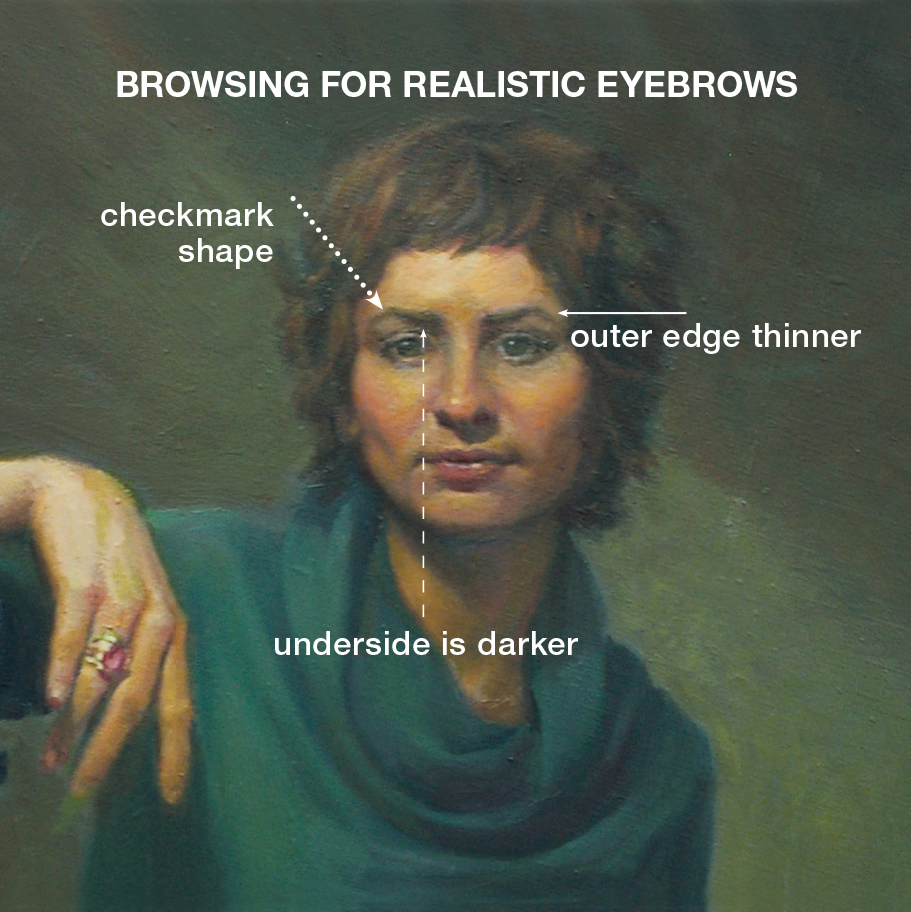
Eyebrows are not a flat solid dark mark, like painted-on eyebrow makeup

1. BROW RIDGE

Eyebrows are slightly lighter at the upper portion of the brow ridge and darker in the lower, shaded part of the brow ridge.

2. OUTER BROW

Eyebrows lighten as the hairs thin out approaching the outer edges of the brow ridge.

3. SHAPE

Overall shape is not straight across the brow ridge but is more of a checkmark shape.

_______________________

About Rob Silverman:

Rob Silverman’s innovative techniques have been featured in American Artist Workshop Magazine and The Art of the Portrait, the official publication of the Portrait Society of America. His work has appeared at Crosby Street Gallery and Spring Studio Gallery in Soho, the Art League of Long Island, Edward Hopper House, The Art Guild of Port Washington, The National Art League, the Lockwood-Mathews Museum, as well as the National Arts Club and Salmagundi Club.

TAG at Home

[catlist name=tag-at-home]

Painting Glass Tips from Ilene Silberstein

Painting Glass Tips from Ilene Silberstein


Painting Glass 
with Ilene Silberstein

During our Flower Power weekend in February, some of the floral still lifes were set up in glass vases. Many of the attendees had questions about how to paint glass.
Here’s a tip: put some flowers in a glass vase (they do not have to be fresh). You can go outside and grab a few stems of Forsythia and try painting  it with the following thoughts in mind:

HIGHLIGHT

  • Many people put many highlights in glass because they think see light reflected in small sparkles. 
    In reality there is only one highlight. You identify it. And that is what you paint.
  • Highlights are the symbol of a plane change.
  • They have a smudginess that moves across the surface. (It is glass after all)
  • The highlight must travel over the glass

WATER

  • The waterline can have a touch of light, but not as bright as the highlight
  • The waterline is subtle and does not go across the entire glass
  • Above the waterline is a touch lighter than below the waterline where there is water
  • Anything in the water has a soft edge

STEMS

  • Stems are split between the top and bottom waterline
  • Anything in the water has a soft edge

Did you try this tip? Share your work with us on Facebook @TheArtGuild or Instagram @artguildpw 

_______________________

About Ilene Silberstein:

   Ilene Silberstein is the Co-President of The Art Guild. Her work emphasizes energy created by shadows and light, and she is drawn to painting natural settings. She works in pastel, oil and mosaic and has studied with the late Anthony Palombo, Howard Rose, Christine LaFuente, Greg Kruetz, David Leffel and Robert A. Johnson. Her work can be viewed at IleneSilberstein.com

TAG at Home

[catlist name=tag-at-home]

Get Your Eyes in Shape by Rob Silverman

Get Your Eyes in Shape by Rob Silverman

The Art Guild, Rob Silverman, art lesson, portrait, portraiture  

How to Get Your Eyes in Shape  
with Rob Silverman

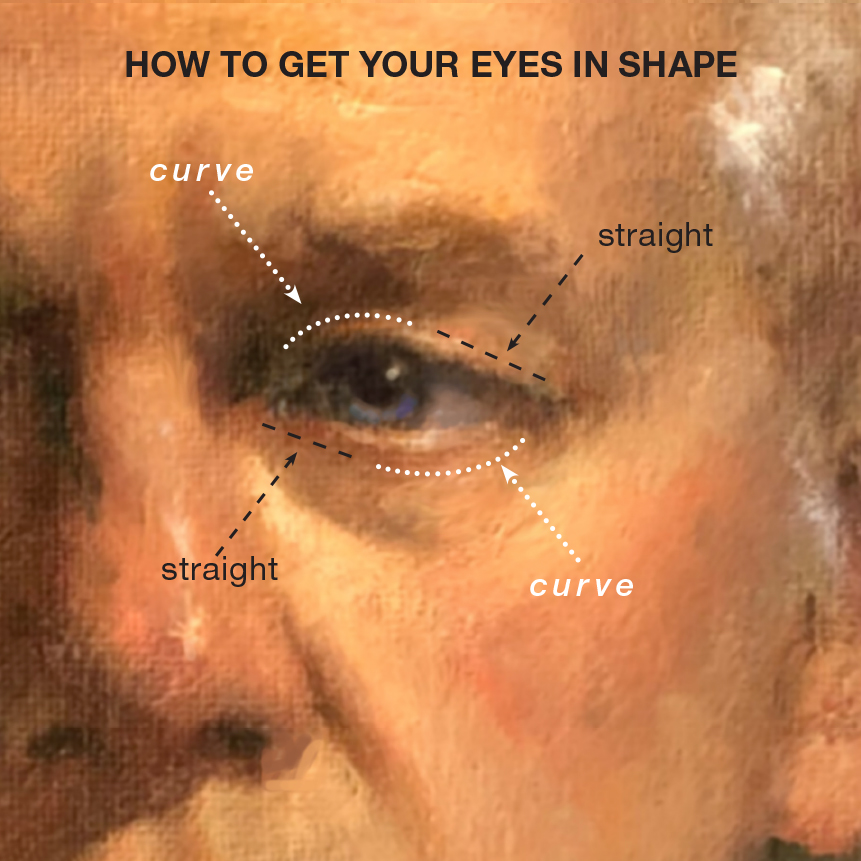
1. THE EYE

The eye is not a symmetrical almond shape like the CBS eye or almond, but rather an asymmetrical combination of a joined curve and a fairly straight edge.

2. UPPER LID

The highest point of the upper lid is on the inside and curved. The rest of the upper lid (on the outside) is relatively straight. 

3. LOWER LID

The lowest point of the lower lid is on the outer side and curved. The rest of the lower lid (on the inside)  is relatively straight.

_______________________

About Rob Silverman:

Rob Silverman’s innovative techniques have been featured in American Artist Workshop Magazine and The Art of the Portrait, the official publication of the Portrait Society of America. His work has appeared at Crosby Street Gallery and Spring Studio Gallery in Soho, the Art League of Long Island, Edward Hopper House, The Art Guild of Port Washington, The National Art League, the Lockwood-Mathews Museum, as well as the National Arts Club and Salmagundi Club.

AMERICA!  April 7 – May 7, 2017

AMERICA! April 7 – May 7, 2017

AMERICA! April 7 – May 7

Reception: Friday April 7, 6-8 pm

“AMERICA!” a Juried Competition and Exhibition. We challenge artists to celebrate the beauty and inspiration that our country offers – through still lifes, landscapes and portraits – from shining sea to your backdoor!

JUROR Howard Rose has been painting in oils since 1989. He teaches privately and at The Art League of Long Island, the National Art League in Douglaston and has given many workshops at The Art Guild. “It is an exciting journey to become an artist and see the world through an artist’s eye. I love the challenge of turning an everyday scene into a successful and exciting painting.” 

Pick-Up
• Sunday May 7: 3:00 – 5:00 pm (Exhibit Closes)     
• Monday May 8: 5:00 – 7:00 pm  

First Place: Lana Ballot, for her pastel painting, Grateful 
Second Place: Leo Bliok, for his oil painting Spring in Central Park
Third place: Diane Bares for her oil painting, Flag Day in Cutchogue.
Honorable mentions: Katherine Criss, Daily Parade
Kathy D’Amato-Smith for her oil panting, Fourth of July
Len Mondschein, for his acrylic painting, June 25, 1876, It’s a Good Day To Die.