ONLINE The Portrait in Colored Pencil Workshop with Jesse Lane, April 17-18, 2021

ONLINE The Portrait in Colored Pencil Workshop with Jesse Lane, April 17-18, 2021

Dramatic Portraits In Colored Pencil with Jesse Lane
April 17-18, 2021  • 10 am – 5 pm
$365M/$400NM

Draw a dramatic, realistic portrait with award-winning artist Jesse Lane. Learn the secrets of turning colored pencil into a Fine Art medium…. creating works as rich and nuanced as any oil painting.

Everyone works on the same portrait as Jesse gives detailed demos, step by step, sharing his signature style… including special tips for creating nuanced skin tones, compelling eyes and realistic hair. Classes are thorough as Jesse breaks down complex rendering into simple shapes.

All skill levels are welcome!   

The workshop includes:

  • Large Screen Demos:  A video camera on Jesse’s drawing board is projected to a large screen so students can easily follow along as they draw.
  • One-on-One Instruction: After each demo, Jesse visits each participant, offering encouragement, answering questions, explaining technique and giving tips individual to each student.
  • Jesse provides high-quality instructional materials, including a reference photo, a glossy tutorial booklet, and the image already outlined on drawing paper. Workbooks also have a complete list of colors for each section.
  • Students are required to bring their own drawing supplies, and a materials list will be distributed well in advance of the workshop.

Take your art to the next level as everyone shares their love of colored pencil in a friendly, relaxed atmosphere.

Update: This workshop has been updated to Online (via Zoom). Days will begin at 10am and end at 5pm, with an hour for lunch. The last hour will be used for individual critiques and feedback for students who want it.  


Supply List

Download the list here: Jesse Lane Supply List


About Jesse Lane: 
Through art, I’ve been able to find something inside myself that changed my life.
Growing up, I often felt alone.  In school, I was struggling with the challenges of dyslexia.  I desperately wanted to find a place in life where I didn’t feel inferior. For years, I bottled up my feelings.  Then I realized they could be a source of inspiration.  I began creating images of personal struggle and intimate emotion. What was hidden for so long became voiced and heard. For the first time, I felt truly seen. I took my weakness and made it my strength. Along the way, I’ve discovered we all share these feelings. They are universal.

When people see my portraits, they’re surprised I work in colored pencil.  I love the precision and versatility of colored pencil. This medium can be as rich and nuanced as any other.  One of my goals is to advance colored pencil in the world of fine art.” 

Jesse Lane (born 1990) lives in The Woodlands, Texas, near Houston.  His earliest teacher was his father, Jerry Lane, a former illustrator and underground cartoonist.  
Jesse earned a degree in visualization from Texas A&M University.  He also studied art in Italy, where he was greatly influenced by the lighting and drama of the master painter Caravaggio.
Jesse’s compelling portraits have appeared on the covers of publications including International Artist and The Artist’s Magazine. Southwest Art Magazine recognized him as one of the nation’s leading young emerging artists, and he’s been featured numerous times in American Art Collector.

Numerous awards include top honors from the Salmagundi Club, International Artist Magazine, the Colored Pencil Society of America and the Hudson Valley Art Association.  Jesse has also been a finalist several times in theInternational Art Renewal Center Salon.

Jesse is represented by RJD Gallery in Bridgehampton, New York.

He works at his home studio in The Woodlands, Texas, where he lives with his wife, Kinsey, a teacher and talented sculptor. Jesse  teaches workshops nationwide.

“Jesse Lane is taking the colored pencil world by storm.” – Colored Pencil Magazine

“For collectors interested in a quickly ascending star in the art world, Lane is one surely to watch.” Fine Art ConnoisseurMagazine

For more about Jessie Lane visit his website.

Jesse Lane Workshop
WORKSHOPS:  Cancellations by the student – more than 90 days: full refund. Under 90 days: $50 non-refundable registration fee is included in the workshop tuition.  Deposit is non-refundable within 14 days of the start of the workshop.  
Let’s Talk About the Mouth with Rob Silverman

Let’s Talk About the Mouth with Rob Silverman


Let’s Talk About the Mouth
with Rob Silverman

1. BETWEEN THE LIPS

The space between the lips is not a straight line: The middle form of the top lip overlaps the lower lip and the 2 lateral forms of the lower lip overlap the upper lip.

2. LIP SIZE

The upper lip is usually wider than the lower lip.

3. LIP CREASES

The part between the lips does not end at it’s outer edges as a truncated line, but as a pouch-like node at the end, which is tilted toward the nose.

Rob teaches New Strategies & Techniques in Portraiture at The Art Guild and online on Mondays. Register here.

_______________________

About Rob Silverman:

Rob Silverman’s innovative techniques have been featured in American Artist Workshop Magazine and The Art of the Portrait, the official publication of the Portrait Society of America. His work has appeared at Crosby Street Gallery and Spring Studio Gallery in Soho, the Art League of Long Island, Edward Hopper House, The Art Guild of Port Washington, The National Art League, the Lockwood-Mathews Museum, as well as the National Arts Club and Salmagundi Club. View his work at silvermanportraits.com

Rob teaches New Strategies & Techniques in Portraiture at The Art Guild and online on Mondays. Register here.

TAG at Home

[catlist name=tag-at-home]

The Art of the Photo Book with Mark Mancher

The Art of the Photo Book with Mark Mancher


The Art of the Photo / Art book
with Mark Mancher

This note is not intended to be a “how-to” create your own Photo/Art book; numerous websites explain the nuts and bolts far better than I could. Instead, it is a paean to, what I believe is, an art form unto itself and to ask the question – why don’t more of us take advantage of the opportunity to highlight our art or create art using the incredible technology available? Technology which allows us to produce, and even self-publish, our own professional quality Photo/Art books? Particularly at this moment in time, when many of us have a story to tell and the time to tell it. 

Particularly at this moment in time, when many of us have a story to tell and the time to tell it. 

In a time when paper and hardcover books are being supplanted by e-books and audible books, one form of publication cannot easily be replaced by technology – Photo and Art Books. Sometimes referred to with some derision as “coffee table” books, large lush examples published by Rizzoli, Taschen and Phaidon ubiquitously grace the tables and bookshelves in almost every shelter magazine layout. We now all have the ability, with limited “tech expertise,” to create publication-quality, hardcover books, which will look right at home resting alongside the best of those publications. 

Books are easy to create online

There are many sites that offer free downloadable software from Shutterfly, Snapfish and many others. Currently, I use a site called Blurb.com. Most of these sites allow wide customization, innumerable fonts and layouts. You choose the dimensions of the book from several options, the number of pages and the quality of the paper. After you upload your images, you control the arrangement and content of each page and design the cover from a variety of choices.  You can insert text in any way you choose. In short, you have broad artistic control.  After you complete that process, you upload your design and send it off (along with a not insignificant, but not prohibitive, fee) for processing. In short order a very finished looking product arrives at your door. 

Art Books are anthologies.

Most commonly, Art Books are anthologies of the work of the world’s best-known artists and fine art photographers. These unquestionably have value. Without traveling the world, an artist’s work can be admired in a single source and traced through its various stages supported by text and quotes which give the art context. The design, editing and editorial content of the book can express a clear point of view and enhance or even critique the art.

Providing an opportunity to share more.

But, for us, the creation of a Photo/Art book provides an even greater opportunity – the ability to create a personal statement or form of expression which goes beyond what a single image or piece can communicate. To present a body of work and explain in images and words our art and motivation. 

For photographers, the subject matter is limitless, from the simplest details of daily life, like tableaus of daily detritus, to the grand sweep of natural landscapes and everything in between.  In its simplest form, a photo book created on-line answers the question “What do you do with your digital photos?” Many, if not most of us have hundreds of photos lying dormant on our computers (and hundreds of hard copy photos and slides that can be digitized sitting in boxes.) A photobook is a worthy replacement for the old photo album with the advantage that it can be customized, duplicated and doesn’t fall apart. It can be a tool to tell a compelling story of personal or family history, travel and life passage events.

Often uncovering themes

As photographers we often find ourselves drawn to certain subjects which we photograph again and again, street scenes, abstract patterns, nature. Why? Collecting these images and adding to a portfolio is a way to examine these interests. The goal of “working on a book” on the subject is a powerful creative motivator to explore and expand on the theme.  The photographs are no longer an expression of random interest, but a way to more fully examine, for others and ourselves, what draws us to the subject and why it is worthy of appreciation. It captures where we are in the moment and preserves it in tangible form for posterity. 

_____________________________

About Mark Mancher:

  Mark Mancher is an avid, lifelong, amateur photographer. He is a past Art Guild Photograph exhibition winner and an exhibitor at the Martin Vogel Photography Gallery.  He has a particular interest in the photobook as art, both as a collector and a photographer.   

TAG at Home

[catlist name=tag-at-home]

A Few More Tips on the Nose with Rob Silverman

A Few More Tips on the Nose with Rob Silverman

portraiture, rob silverman, portraits, nose, nose tips, painting tips, oil tip  

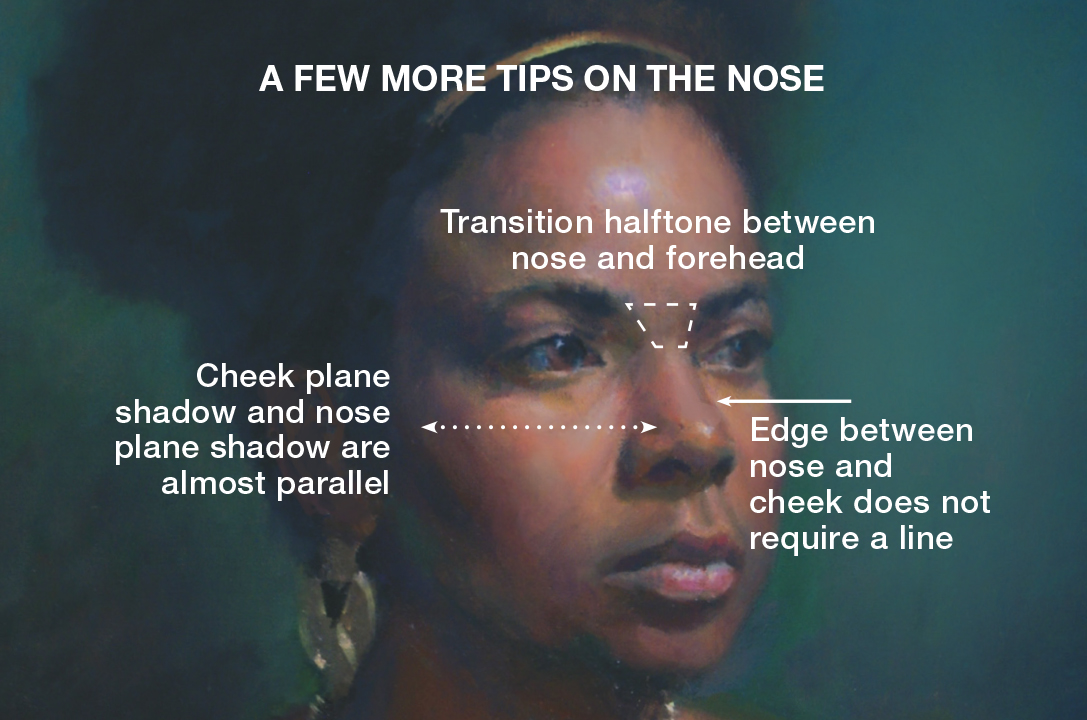
A Few More Tips on the Nose
with Rob Silverman

1. NASAL STRUCTURE

Trapezoid shape, the glabella, between nose and forehead is turned down at an angle, creating a slight halftone.

2. PROFILE

Avoid delineating the bridge of the nose (the side that is turned away from the light source) with a hard line. Use a slight tonal change instead.

3. SHADOW

Nose side plane and cheek plane are familial—the planes are generally parallel, although the nose shadow is made a bit lighter from the reflected light bouncing from the cheek.

_______________________

About Rob Silverman:

Rob Silverman’s innovative techniques have been featured in American Artist Workshop Magazine and The Art of the Portrait, the official publication of the Portrait Society of America. His work has appeared at Crosby Street Gallery and Spring Studio Gallery in Soho, the Art League of Long Island, Edward Hopper House, The Art Guild of Port Washington, The National Art League, the Lockwood-Mathews Museum, as well as the National Arts Club and Salmagundi Club. View his work at silvermanportraits.com

Rob teaches New Strategies & Techniques in Portraiture at The Art Guild on Mondays.

TAG at Home

[catlist name=tag-at-home]

More Nose Knowledge with Rob Silverman

More Nose Knowledge with Rob Silverman

nose, nose tips, portrait, portraiture, portraiture tips, TAG at home, The Art Guild  

More Nose Knowledge
with Rob Silverman

1. NASAL BONE

The end of the nasal bone creates a slight bump in the bridge of the nose

2. PROFILE

In profile the nose is half on the face, and half off

3. SHADOW

Minimize the contrast between the nostrils and the shadow plane of the lower portion of the nose, so that the nostrils don’t appear as punched holes

_______________________

About Rob Silverman:

Rob Silverman’s innovative techniques have been featured in American Artist Workshop Magazine and The Art of the Portrait, the official publication of the Portrait Society of America. His work has appeared at Crosby Street Gallery and Spring Studio Gallery in Soho, the Art League of Long Island, Edward Hopper House, The Art Guild of Port Washington, The National Art League, the Lockwood-Mathews Museum, as well as the National Arts Club and Salmagundi Club. View his work at silvermanportraits.com

Rob teaches New Strategies & Techniques in Portraiture at The Art Guild on Mondays.

TAG at Home

[catlist name=tag-at-home]